THE POWER OF A THOUGHT
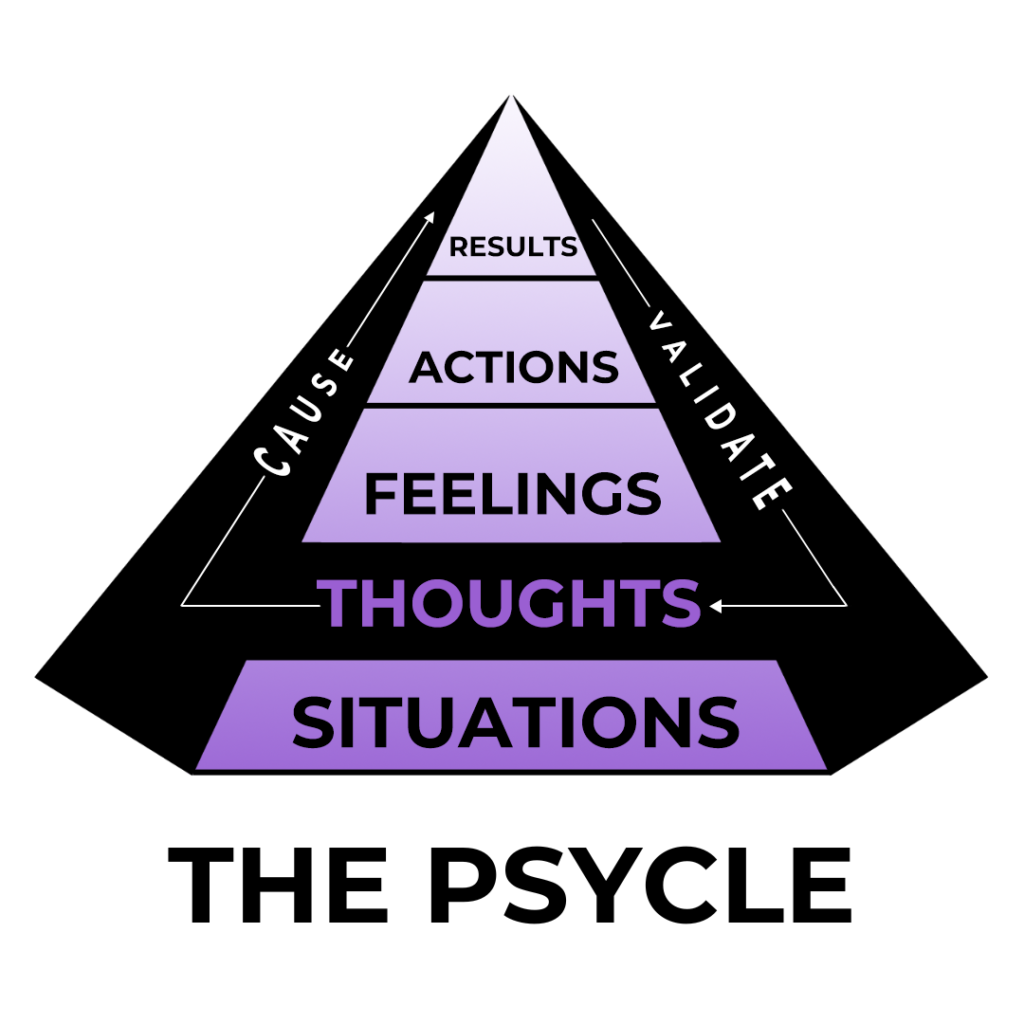
The psycle utilizes psychology to help optimize your mindset so you can consistently perform at peak levels and maximize your potential. It incorporates elements of cognitive behavioral therapy2 (CBT) and situational awareness3 (SA) to help you control your mindset in areas you may have struggled with throughout your athletic career, new situations that may affect your performance, as well as the dynamic and ever changing environment of competition. The psycle is comprised of five fundamental components that provide insight into your mind and a method to supervise your brain. The five components are situations, thoughts, feelings, actions, and results. It is imperative that you not only learn each element but also understand their interconnected relationships and the cycle they create. Mastering this cycle will propel your mindset to a place that unleashes your athletic potential and enables you to consistently perform at peak levels.
Situations: the objective things that happen in your life as an athlete that are out of your control.
Detail: these are the facts of your athletic life and are neither good nor bad but neutral in nature until you have a thought about them.
Examples: your height, what people say about you, the weather, your competitors, your past.
Tip: your situations do not control your potential or your ability to consistently perform at peak levels.
Thoughts: your subjective beliefs about your situations.
Details: self-talk that provides a running monologue about your athletic life throughout the day.
Examples:
- Look how much more muscular he is than me, there is no way I can win.
- I may be the smallest but I am also the fastest.
- I can’t believe it is raining, I never compete well in bad weather.
- I have executed my training plan perfectly all season, a rainy day can’t phase me.
- Maybe they are right, maybe I can’t compete at this level.
- I don’t care what they say, I am going to let my actions do the talking.
Tip: you have the choice to think in a manner that aligns with your desired athletic results regardless of the situation.
Feelings: the emotions caused by your thoughts.
Detail: a one word description.
Examples: angry, anxious, ashamed, competitive, confident, courageous, defeated, depressed, determined, disappointed, discouraged, dominant, doubtful, embarrassed, excited, fearful, frustrated, guilty, happy, joyful, motivated, peaceful, sad, satisfaction, successful, surprised, and victorious.
Tip: everything you do as an athlete is for a feeling. You want the record, the win, the championship title…all for that feeling! Because thoughts cause feelings, there is huge value in getting control over your thought process.
Actions: the behavior generated by your feelings.
Detail: can be an action, inaction, or reaction.
Examples:
- Drinking extra fluids vs. not drinking extra fluids
- Lifting weights vs. Not lifting weights
- Pushing through the pain during interval training vs. Not giving it your all during interval training
- Fighting for 3rd place vs. Settling for 4th place
Tip: every single action you take is completely in your control and should align with your desired athletic results.
Results: the outcomes produced by your actions.
Detail: your result will always validate your original thought.
Examples:
- Good hydration vs. Poor hydration
- Increased strength vs. Less strong
- Extremely fit vs. Less fit
- On the podium vs. Not on the podium
Tip: if you do not like your results, you need to re-evaluate your thoughts.
Summary
Situations: Your athletic life is filled with situations.
Thoughts: You have thoughts about your situations.
Feelings: Each thought causes a feeling.
Actions: Every feeling causes an action.
Results: Your action causes a result.
Change your results by changing your thoughts.
Let’s look at some examples that show the psycle in action and feature you as the runner. Notice how the same situation yields different results based on your thoughts, feelings and actions. Psycle A is a negative psycle in which your mind is fighting against you while Psycle B is a positive psycle in which your mindset is aligned with the athletic results you seek.
Runner Situation 1: You are a miler who gets “boxed in” during the first half of the race.
- Thought A: You start to panic and tense up as your game plan to be in a good position with a lap to go is in jeopardy.
- Feeling A: You feel frustrated.
- Action A: You decide to fight your way out of the pack and spend a bunch of energy trading elbows and pushing your way through other runners.
- Result A: By the time you are out of the pack and the “real” race begins at the bell lap, you are too exhausted to respond. You end up getting passed by the same runners who initially boxed you in and run a slow time.
- Thought B: You want to be in a good position with a lap to go and will stay calm and relaxed as you look for your opportunity to get there.
- Feeling B: You feel confident.
- Action B: You let the pack suck you along effortlessly and as the bell lap approaches, the pace picks up and it creates space for you to make your move.
- Result B: You strike with a furious kick and finish in second place with a new PR.
Runner Situation 2: In a track meet against your cross town rivals, you have a poor performance in the 800m and not only lose to your biggest competitor but run a slow time in the process.
- Thought A: You start to question your ability as a runner and whether all the training is worth the effort if slow times and losing are going to be the end result.
- Feeling A: You feel defeated.
- Action A: You don’t put much effort into training the remainder of the season.
- Result A: Your race times show it as you stop improving.
- Thought B: You know you can do better than this and can’t wait to prove it at League Finals when you get to race her again.
- Feeling B: You feel motivated.
- Action B: You train really hard and put in the extra effort the rest of the season.
- Result B: When you race the competitor from your rival school again at League Finals, you run a PR (personal record) to beat her.
Runner Situation 3: Two miles into a 5k cross country race, a pack of runners pass you going up a long, steep, and challenging hill.
- Thought A: You are hurting pretty bad and decide to just let them go on by without a fight.
- Feeling A: You feel discouraged.
- Action A: You give up and don’t push yourself as hard as you could have.
- Result A: You get beat by 5 runners you typically run faster than and your team finishes in a disappointing 3rd place.
- Thought B: They may have got you on the hill but you are not giving up. There is still a mile to go and there is nothing that is going to stop you from catching back up to that pack.
- Feeling B: You feel determined.
- Action B: You keep your eye on the pack as you slowly reel them back in and ultimately pass them towards the end of the race.
- Result B: Your performance helps lower your team score enough to win the meet.
Athletics are dynamic and there are multiple situations occurring simultaneously throughout a competition. Not only being aware of all the different situations but also making mindset decisions based on the desired results is imperative to peak performance. Each positive psycle yields a desired result. The more positive psycles you execute the more you experience peak performance. The more you master the psycle the more consistent your peak performance becomes. Stack positive psycles over time and you start maximizing potential. That is the power of the psycle!
The psycle and its role in the mental game is so important because the cause of all of your feelings, actions, and results is always going to be a thought. You must pay attention to what is going on in your head because it is responsible for every emotion, behavior and result you get. Ripkik is dedicated to helping improve your thought process so that regardless of your situations your feelings and actions align with your desired athletic results.
Notes
2. Wikipedia, Cognitive Behavioral Therapy, https://en.wikipedia.org/wiki/Cognitive_behavioral_therapy, retrieved June, 9 2021.
3. Wikipedia, Situational Awareness, https://en.wikipedia.org/wiki/Situation_awareness, retrieved June, 9 2021.